Table of Contents
9. Half Notes & Whole Notes
Theory Lesson: Let It Ring
Music needs to breathe! If you just played fast notes on every single beat, it would sound exhausting. Sometimes, we want a note to ring out and fill the space.
The Whole Note
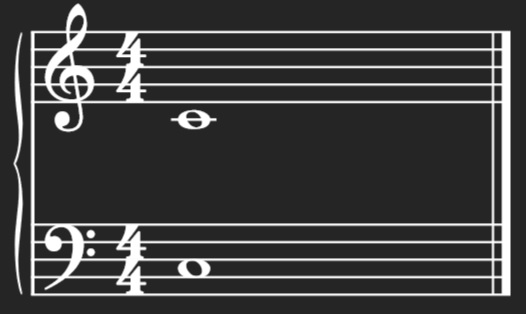
A whole note looks like an empty, hollow oval with no stem. In 4/4 time, a whole note takes up the entire measure. It gets exactly four beats. When you play a whole note, you press the key on Beat 1, and you hold that key down through Beats 2, 3, and 4 before letting go.
The Half Note
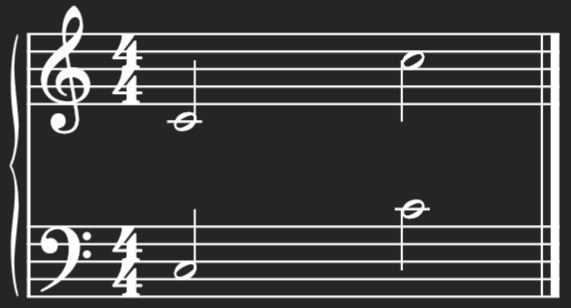
A half note looks a lot like a whole note (an empty oval), but it has a straight stem attached to it. Just like the name says, it is worth exactly half of a whole note. In 4/4 time, a half note gets two beats.
This means you can fit two half notes into a single measure. You would play the first one on Beat 1 (holding it through Beat 2), and play the second one on Beat 3 (holding it through Beat 4).
Self-Check Questions
- Question: How many total beats do you get if you add one half note and two quarter notes together?
Click to reveal answer
Answer: Four beats! (2 + 1 + 1). - Question: Visually, what is the quickest way to tell the difference between a quarter note and a half note?
Click to reveal answer
Answer: A quarter note is solid/filled in with black, while a half note is hollow/empty in the middle. - Question: How many whole notes can you fit into a standard 4/4 measure?
Click to reveal answer
Answer: Exactly one. It takes up the entire measure!
Practice Session: Holding Notes
The Goal: Train yourself to hold keys down for their exact mathematical length without cutting them short.
The Execution: Open JazzPianoLab and run through these Rhythm exercises:
- 9.1 Whole Notes: The Four-Beat Hold: Practice pressing a key and holding it down patiently for a full four clicks before moving on.
- 9.2 Half Notes: The Two-Beat Step: Walk up and down the keyboard holding each note for exactly two clicks.
- 9.3 Mixed Rhythms: Single Key: Switch between whole, half, and quarter notes on the exact same key to test your internal rhythm math.
- 9.4 Hand Independence: Hold and Play: A great brain workout! Your right hand holds a long whole note while your left hand plays four quarter notes beneath it. Then switch hands.
Don't have JazzPianoLab yet?
Reading about theory is only half the battle. To truly learn sight-reading, your hands need to react instantly. Plug in your MIDI keyboard and let our interactive engine guide you through these exact exercises.
Start 7-Day Free Trial (No Credit Card)Ready to build your musical foundation?
Unlock Interactive Practice for this course and the entire JazzPianoLab training library today.