Table of Contents
13. Dotted Rhythms & Skipping Beats
Theory Lesson: Catching the Groove
Music isn't always split perfectly down the middle. Some of the best grooves have a bouncy, "long-short" feel to them. We create this skipping feel by putting a tiny dot right next to a note.
The Golden Rule of the Dot
A dot doesn't have a set speed. It's actually just a cool math trick:
Rule: A dot adds exactly 50% of the note's original length to its total time.
The Dotted Half Note
- Original length of a Half Note = 2 Beats.
- Half of 2 = 1 Beat.
- 2 + 1 = 3 Beats total!
A dotted half note takes up exactly three beats. You will usually see it paired with a regular quarter note to finish out a standard 4-beat measure (3 + 1 = 4).
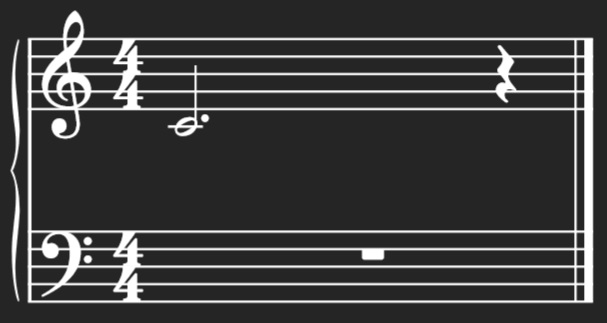
The Dotted Quarter Note
This is where the groove really starts.
- Original length of a Quarter Note = 1 Beat.
- Half of 1 = 0.5 Beats (an eighth note).
- 1 + 0.5 = 1.5 Beats total.
A dotted quarter note lasts for one and a half beats. Because it leaves exactly half a beat hanging, it is almost always followed by a single eighth note to round things out. This is what creates that classic "long-short" skipping groove you hear all the time in pop, rock, and jazz.
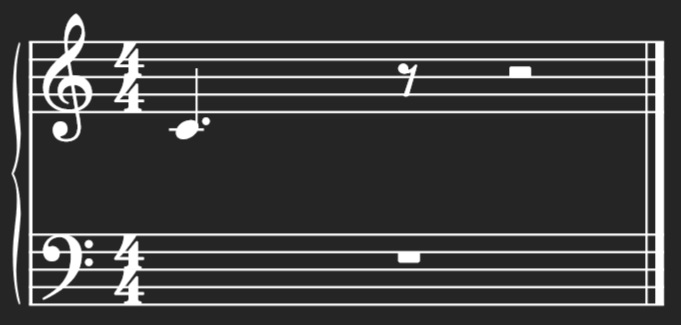
The Dotted Eighth Note
We can take that skip and make it even tighter.
- Original length of an Eighth Note = 0.5 Beats.
- Half of 0.5 = 0.25 Beats (a 16th note).
- 0.5 + 0.25 = 0.75 Beats total.
A dotted eighth note lasts for three-quarters of a beat. Because it leaves a tiny 0.25 slice hanging, it is almost always paired with a single 16th note. This creates a much sharper, snappier skip than the dotted quarter note.
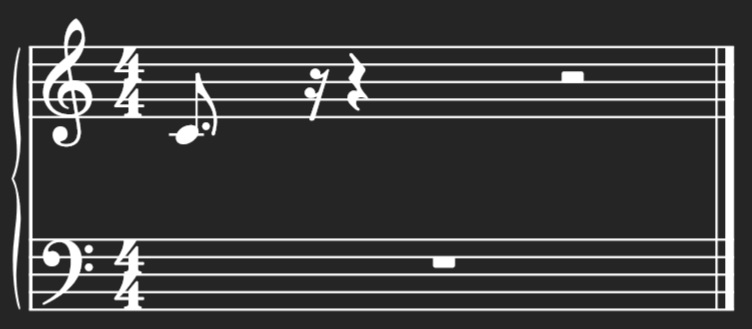
The Secret Tie Trick
If reading a dotted note ever makes your brain hurt, just remember this trick: any dotted note can be rewritten as two tied notes! For example, a dotted quarter note (1.5 beats) sounds exactly the same as a quarter note tied to an eighth note (1 + 0.5 = 1.5). If you get stuck, just imagine the dot is a tie.

Self-Check Questions
- Question: How many beats total does a dotted whole note get?
Click to reveal answer
Answer: Six beats (4 original beats + 2 added beats). - Question: If you play a dotted quarter note exactly on Beat 1, on what count do you play the single eighth note that follows it?
Click to reveal answer
Answer: On the "and" of Beat 2. - Question: What tiny note usually follows a dotted eighth note to finish the beat?
Click to reveal answer
Answer: A 16th note. - Question: What is the golden rule of the dot?
Click to reveal answer
Answer: It always adds exactly 50% of the note's original length to its total time.
Practice Session: Mastering the Skip
The Goal: Internalize the long-short feel of dotted rhythms so they feel like a natural groove instead of a math equation.
The Execution: Open JazzPianoLab and run through these Rhythm exercises:
- 13.1 Dotted Halves: The 3-Beat Hold: Practice holding a dotted half note for exactly three clicks and releasing perfectly on beat four.
- 13.2 Dotted Quarters & Eighths: The Classic Skip: Play continuous pairs of dotted quarters and eighth notes to lock in that standard bouncy pop groove.
- 13.3 Dotted Melodies: Putting It Together: Read and play a full melody that mixes all of these bouncy, dotted rhythms together!
Don't have JazzPianoLab yet?
Reading about theory is only half the battle. To truly learn sight-reading, your hands need to react instantly. Plug in your MIDI keyboard and let our interactive engine guide you through these exact exercises.
Start 7-Day Free Trial (No Credit Card)Ready to build your musical foundation?
Unlock Interactive Practice for this course and the entire JazzPianoLab training library today.