Table of Contents
21. Reaching Wider (6ths & 7ths)
Theory Lesson: Stretching Further
Now we are pushing into the outer limits of your hand's reach. When the gaps on the page get this wide, stopping to count lines and spaces will completely derail your playing. You have to rely entirely on spotting visual shapes and trusting your muscle memory.
Spotting the 6th
A 6th spans six notes in a scale. Just like the 2nd and the 4th, it breaks symmetry and looks "mixed" on the staff:
- If the bottom note is on a Line, the top note is on a Space.
- If the bottom note is on a Space, the top note is on a Line.
Visually, it looks like a nice, stable 5th that just got stretched a little too far. Physically, your hand will be quite open, usually using your thumb (1) and pinky (5), but without the tight tension of a full octave stretch.
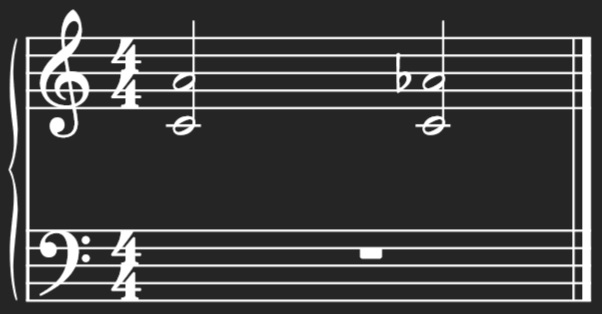
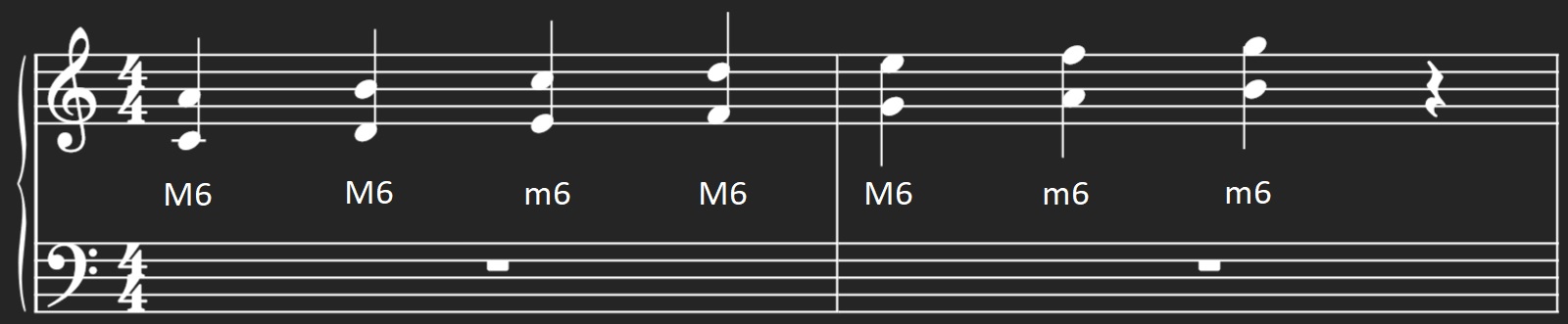
White Key 6ths in C Major
If you stay strictly on the white keys, you'll naturally hit 4 Major 6ths (M6) and 3 Minor 6ths (m6).
Spotting the 7th
The 7th spans seven notes. Because it is an odd number, it brings back that perfect symmetry we saw with 3rds and 5ths:
- Line to Line: (Skipping exactly two lines in the middle).
- Space to Space: (Skipping exactly two spaces in the middle).
The 7th creates a very distinct, tense, "crunchy" sound that wants to resolve. Physically, the easiest way to find it is a cheat: it feels exactly like playing an octave, but you pull your pinky (or thumb) inward by exactly one white key.
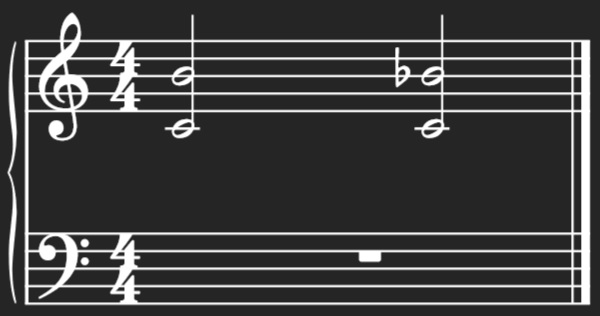
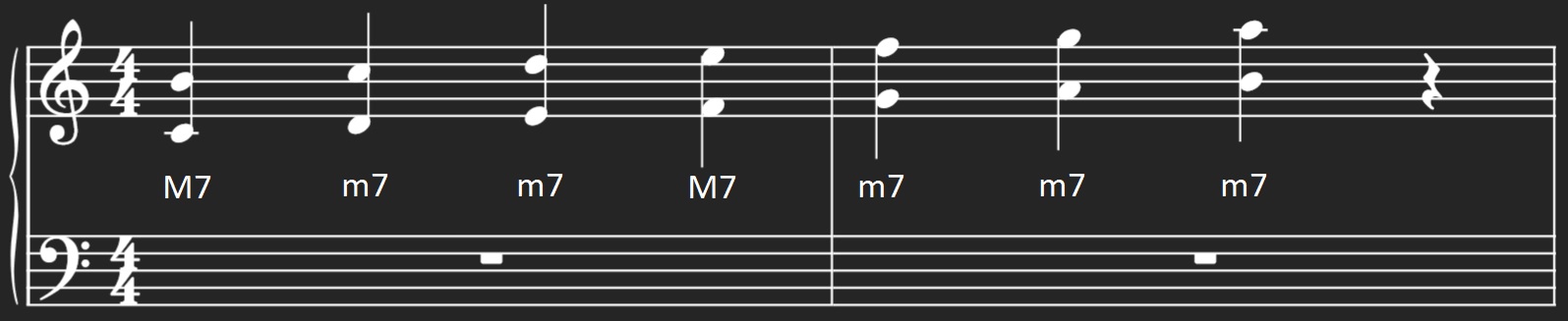
White Key 7ths in C Major
Sticking to the white keys here gives you a beautiful mix of 2 Major 7ths (M7) and 5 Minor 7ths (m7).
Self-Check Questions
- Question: If an interval is stacked with the bottom note on a line, and the top note way up on a space, is it a 5th or a 6th?
Click to reveal answer
Answer: A 6th! Remember, 5ths are perfectly symmetrical (line-to-line or space-to-space). 6ths always look mixed. - Question: What does a 7th visually have in common with a 3rd and a 5th?
Click to reveal answer
Answer: They are all perfectly symmetrical (always line-to-line or space-to-space). - Question: What is the physical "cheat code" for quickly finding a 7th on the keyboard?
Click to reveal answer
Answer: Stretch your hand out to a full octave, then pull your pinky (or thumb) inward by one white key.
Practice Session: The Big Reaches
The Goal: Train your eyes to instantly spot the difference between the mixed 6th and symmetrical 7th, and get your hand comfortable with these wider stretches.
The Execution: Open JazzPianoLab and run through these Sight-Reading exercises:
- 21.1 The 6th Stretch: Walk up the C Major scale playing harmonic 6ths. Feel that wide, but comfortable, thumb-to-pinky reach.
- 21.2 Major 6ths: Focus purely on isolating Major 6ths across the keyboard.
- 21.3 Minor 6ths: Focus purely on isolating Minor 6ths across the keyboard to hear and feel the difference.
- 21.4 The 7th Crunch: Walk up the C Major scale playing harmonic 7ths. Lean into that tense, jazzy sound!
- 21.5 Major 7ths: Focus purely on isolating Major 7ths across the keyboard.
- 21.6 Minor 7ths: Focus purely on isolating Minor 7ths across the keyboard to hear and feel the difference.
- 21.7 Mixed 6ths and 7ths: A randomized blend of 6ths and 7ths to test if your eyes can instantly spot the symmetry change and adjust your hand span.
Don't have JazzPianoLab yet?
Reading about theory is only half the battle. To truly learn sight-reading, your hands need to react instantly. Plug in your MIDI keyboard and let our interactive engine guide you through these exact exercises.
Start 7-Day Free Trial (No Credit Card)Ready to build your musical foundation?
Unlock Interactive Practice for this course and the entire JazzPianoLab training library today.