Table of Contents
2. The Treble Clef & Your Right Hand
Theory Lesson: Reading with Your Right Hand
Think of sheet music like a simple graph: time moves from left to right, and pitches go up and down. To map this out, we use a staff—a set of five horizontal lines and the four spaces between them.
But since the piano has 88 keys, five lines aren't enough to cover everything. We need a symbol to tell us exactly which part of the keyboard we are looking at. That is where the Clef comes in.
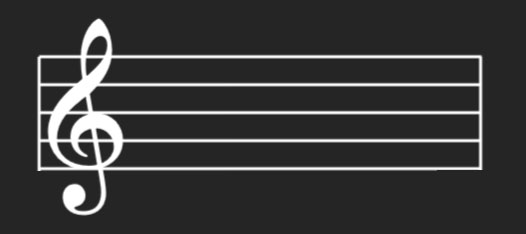
The Treble Clef (or G-Clef)
You have probably seen this curly symbol before! It sits at the far left of the staff. Musicians often call it the G-Clef because the inner swirl wraps right around the second line from the bottom, acting like a bullseye. It tells us: "The note on this line is G."
Because the Treble Clef is used for higher-sounding notes, you will almost always play these with your right hand.
Learning the Lines and Spaces
Experienced players don't actually read note-by-note—they read visual patterns. But to get to that level, you first need to learn where the notes live on this five-line grid:
- The Lines (Bottom to Top): E, G, B, D, F. (A fun way to remember this is: Every Good Boy Deserves Fudge).
- The Spaces (Bottom to Top): F, A, C, E. (Notice how the spaces neatly spell the word FACE!).

Connecting Your Eyes to Your Hands
The real trick to sight-reading isn't just memorizing "FACE". The goal is to see that note on the page and instantly move your finger to the right key without thinking about it. We want to stop translating dots into letters, and start translating them directly into physical movement.
Self-Check Questions
- Question: If a note is sitting on the very bottom line of the Treble staff, what note is it?
Click to reveal answer
Answer: It is an E. - Question: If you step up from that bottom line into the very first space, what note is it?
Click to reveal answer
Answer: It is an F. - Question: The inner curl of the Treble Clef acts as a bullseye for which line and note?
Click to reveal answer
Answer: It wraps around the second line from the bottom, telling us that line is G.
Practice Session: Right-Hand Basics
The Goal: Get totally comfortable finding the main right-hand notes on the staff.
The Execution: Load the following scenarios inside the JazzPianoLab app. Use Wait-For-Note mode to build physical muscle memory without rushing.
- 1. Treble Lines (E, G, B, D, F): Focus only on the five lines. Remember: Every Good Boy Deserves Fudge!
- 2.1 Treble Spaces (F, A, C, E): Give the lines a break and practice just the spaces.
- 2.2 Treble Integration: Put it all together and practice reading anywhere inside the main staff.
Don't have JazzPianoLab yet?
Reading about theory is only half the battle. To truly learn sight-reading, your hands need to react instantly. Plug in your MIDI keyboard and let our interactive engine guide you through these exact exercises.
Start 7-Day Free Trial (No Credit Card)Ready to build your musical foundation?
Unlock Interactive Practice for this course and the entire JazzPianoLab training library today.