Table of Contents
19. Melodic & Harmonic Intervals (2nds & 3rds)
Theory Lesson: Stacking the Notes
An interval is just the musical word for the distance between two notes. Up until today, you have only played notes one by one, reading left to right across the page. Now, it's time to start stacking notes vertically and playing them at the exact same time.
Melodic vs. Harmonic
How an interval is drawn on the page tells your hands exactly how to play it:
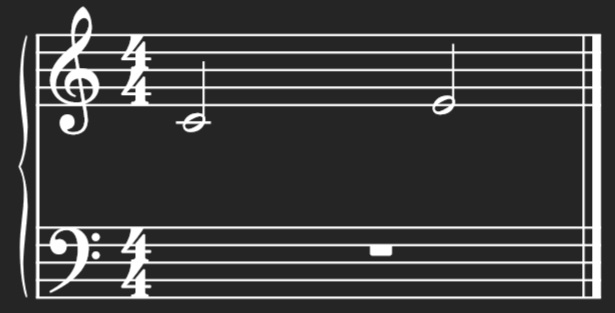
- Melodic Intervals: Notes are written side-by-side. You play them one after another (like a melody). You press the first key, let it go, and then press the second key.
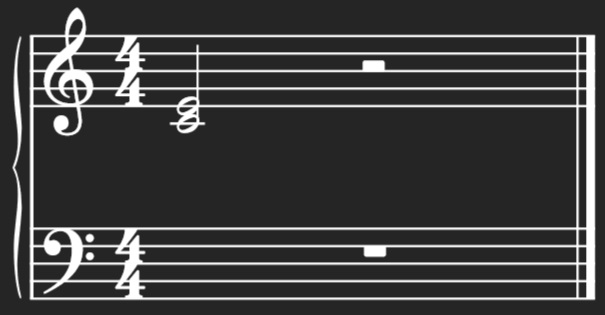
- Harmonic Intervals: Notes are stacked vertically, right on top of each other. You press both keys at the exact same time (like a harmony).
Staying in the Key (Diatonic)
Before we look at specific intervals, you need to know the word Diatonic. Playing "diatonically" just means staying strictly inside the safe notes of your key signature. For example, if we are in C Major, playing diatonically means we only use the natural white keys—no accidentals. If we start sneaking in black keys (sharps or flats), those are called Chromatic notes.
Reading 2nds
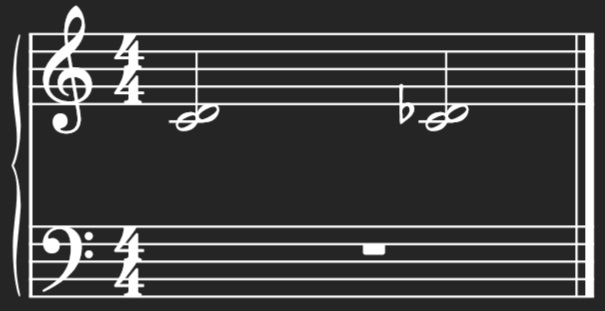
A 2nd is the distance of two steps in a scale (like C to D). Because the notes are physically so close together, they can't be stacked perfectly on the staff—the note heads would crash into each other! Instead, harmonic 2nds are drawn slightly offset, touching side-by-side.
- Major 2nd: Exactly 2 half-steps (a whole step) apart. It has an open sound, and your fingers will have a normal amount of space between them.
- Minor 2nd: Exactly 1 half-step apart. This is a very tight, crunchy, spooky sound (think of the Jaws theme). Your fingers will often be crammed right next to each other.
Note: On the sheet music, a Major 2nd and a Minor 2nd look exactly the same! You have to look at the key signature or any accidentals next to the note to know which exact keys to press.
Diatonic 2nds in C Major
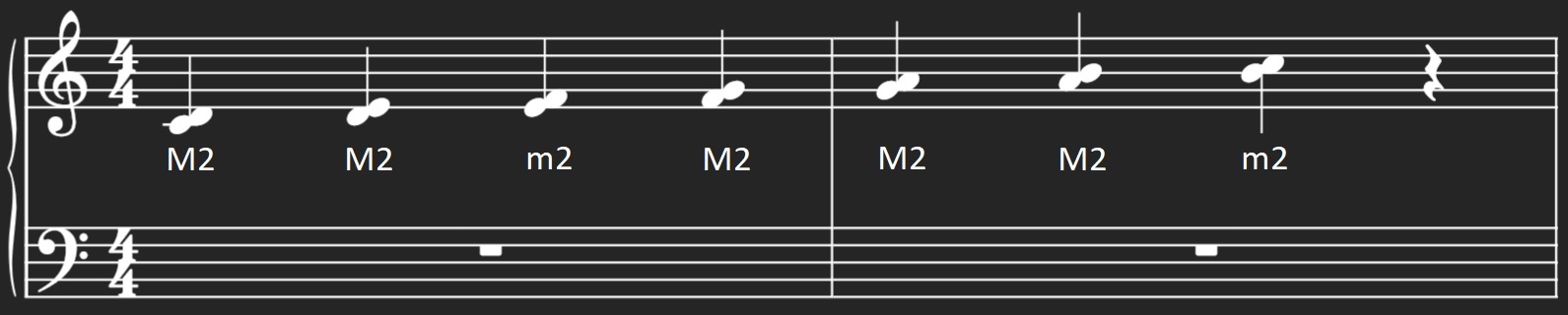
If you only play the white keys, almost all the 2nds you play will automatically be Major 2nds (M2). There are only two exceptions on the entire keyboard: E-F and B-C. Because there is no black key between them, they naturally form tight Minor 2nds (m2).
Reading 3rds
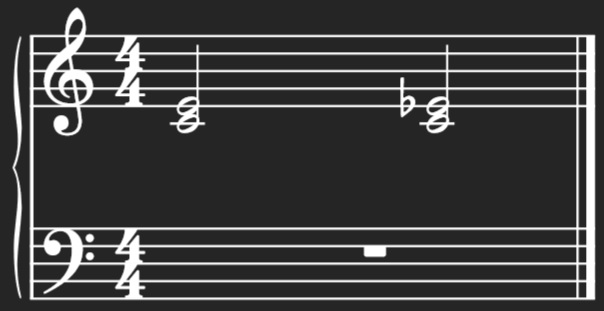
The 3rd is the magic building block for almost all chords. A harmonic 3rd looks incredibly neat on the staff. It is always perfectly symmetrical: either Line-to-Line or Space-to-Space. When your eyes see this snowman shape, your hand should instantly lock into a 1-3 or 2-4 finger shape.
- Major 3rd: Exactly 4 half-steps apart. It has a bright, happy sound and feels a bit wider in your hand.
- Minor 3rd: Exactly 3 half-steps apart. It has a darker, sadder sound and feels physically tighter than the Major 3rd.
Just like 2nds, Major and Minor 3rds look identical on the staff lines. You have to use the key signature and accidentals to tell them apart.
Diatonic 3rds in C Major
When you build 3rds using only the white keys, they are a mixed bag. There are exactly three naturally occurring Major 3rds (M3): C-E, F-A, and G-B. The other four 3rds (D-F, E-G, A-C, B-D) are all naturally Minor 3rds (m3).

Self-Check Questions
- Question: What is the visual difference between a harmonic 2nd and a harmonic 3rd on the sheet music?
Click to reveal answer
Answer: A 2nd has notes touching side-by-side. A 3rd is stacked perfectly symmetrically on top of each other (line-to-line or space-to-space). - Question: Can you tell if a 3rd is Major or Minor just by looking at its shape on the staff?
Click to reveal answer
Answer: No! The shape is identical. You have to read the accidentals or the key signature to know the exact distance. - Question: What is the physical difference between playing melodic and harmonic intervals?
Click to reveal answer
Answer: Melodic intervals are played one after another. Harmonic intervals require you to press both keys at the exact same time.
Practice Session: Playing Together
The Goal: Train your eyes to quickly recognize the shapes of 2nds and 3rds, and train your hand to lock into the correct spacing automatically.
The Execution: Open JazzPianoLab and run through these Sight-Reading exercises:
- 19.1 The Translation Game: Play intervals melodically (one by one) and then harmonically (together) to feel how the shapes translate to your hand.
- 19.2 The C Major 2nd Walk: Walk up the C Major scale playing harmonic 2nds on the white keys.
- 19.3 The Crunchy 2nd Mix: A tricky mix of open Major 2nds and tight, crunchy Minor 2nds.
- 19.4 The C Major 3rd Walk: Walk up the C Major scale playing perfectly stacked harmonic 3rds.
- 19.5 Major & Minor 3rds: Train your ear and fingers to switch between the bright Major 3rds and darker Minor 3rds.
- 19.6 The White Key Jumper: A completely random mix of 2nds and 3rds, but keeping things safely on the white keys.
- 19.7 The Chromatic Obstacle Course: The ultimate test. A wild mix of 2nds and 3rds jumping across both white and black keys!
Don't have JazzPianoLab yet?
Reading about theory is only half the battle. To truly learn sight-reading, your hands need to react instantly. Plug in your MIDI keyboard and let our interactive engine guide you through these exact exercises.
Start 7-Day Free Trial (No Credit Card)Ready to build your musical foundation?
Unlock Interactive Practice for this course and the entire JazzPianoLab training library today.