Table of Contents
11. Eighth Notes & Playing Faster
Theory Lesson: Playing Between the Clicks
So far, every note you have played has matched up perfectly with the click of the metronome. But music often moves faster than the main beat! To play faster rhythms, we split the quarter note right down the middle to create Eighth Notes.
The Math of the Eighth Note
Since an eighth note is exactly half the length of a quarter note, it takes two of them to make up a single beat. In 4/4 time, that means you can fit eight eighth notes into a single measure.
Visualizing the Speed
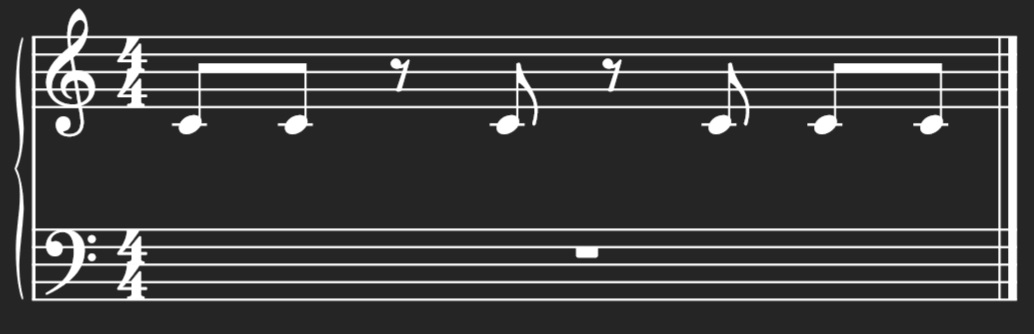
A single eighth note looks just like a quarter note, but it has a little "flag" hanging off the stem.
However, reading a bunch of flags can get messy. When two or more eighth notes sit next to each other, we connect their stems with a solid horizontal line called a beam. This groups the notes by the beat, making it much easier for your eyes to read quickly.
Counting with "And"
When playing eighth notes, you have to count the empty space between the metronome clicks. We do this by saying the word "and".
Try counting a full measure out loud like this: "1 and 2 and 3 and 4 and".
The numbers should land exactly on the metronome click (we call this the downbeat), and the "ands" should land perfectly in the middle (we call this the upbeat).
The Eighth Rest
Just like an eighth note means half a beat of sound, an eighth rest means half a beat of silence. It looks a bit like a fancy number "7". If you see an eighth rest right on the main beat, you stay totally quiet on the metronome click, and press the key exactly on the suspended "and"!
Self-Check Questions
- Question: How many eighth notes does it take to equal the length of one half note?
Click to reveal answer
Answer: Four eighth notes (since a half note is worth 2 beats, and there are 2 eighth notes per beat). - Question: When counting eighth notes out loud, what lands exactly on the metronome click: the number, or the "and"?
Click to reveal answer
Answer: The number! (The "and" falls in the space between the clicks). - Question: What is the horizontal line that connects multiple eighth notes together called?
Click to reveal answer
Answer: A beam. - Question: How long does an eighth rest last?
Click to reveal answer
Answer: Exactly half of one beat.
Practice Session: Catching the Upbeat
The Goal: Learn to comfortably play notes right in the middle of the metronome clicks.
The Execution: Open JazzPianoLab and run through these Rhythm exercises:
- 11.1 Eighth Notes: Single Key: Play steady eighth notes on one key. Focus on making the upbeats (the "ands") perfectly even with the downbeats.
- 11.2 Shifting Gears: Quarters to Eighths: Alternate between playing a measure of quarter notes and a measure of eighth notes to feel the speed double and cut in half.
- 11.3 Off-Beat Strikes: Eighth Rests: Rest on the click, and strike only on the "and" of the beat to build off-beat coordination.
- 11.4 Eighth Note Scale: C Major: Play the C Major scale using continuous eighth notes to build speed without losing your timing. Fingering Tip for C Major (1 = Thumb, 5 = Pinky):
• Right hand going up: 1-2-3, tuck thumb under, 1-2-3-4-5.
• Right hand going down: 5-4-3-2-1, cross 3rd finger over, 3-2-1.
• Left hand going up: 5-4-3-2-1, cross 3rd finger over, 3-2-1.
• Left hand going down: 1-2-3, tuck thumb under, 1-2-3-4-5.
Don't have JazzPianoLab yet?
Reading about theory is only half the battle. To truly learn sight-reading, your hands need to react instantly. Plug in your MIDI keyboard and let our interactive engine guide you through these exact exercises.
Start 7-Day Free Trial (No Credit Card)Ready to build your musical foundation?
Unlock Interactive Practice for this course and the entire JazzPianoLab training library today.