Table of Contents
4. Middle C & The Grand Staff
Theory Lesson: Bringing Both Hands Together
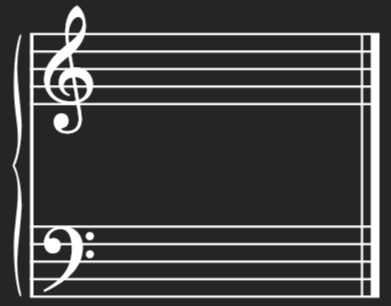
So far, we have looked at the Treble Clef (right hand) and Bass Clef (left hand) as two totally separate things. But in real piano music, they team up to form the Grand Staff.
The Grand Staff uses a big bracket on the left side to connect the top and bottom staves, letting you know you should read and play them at the same time. But how do these two different maps actually connect on your keyboard?
The Invisible Line in the Middle
The secret to the Grand Staff is hidden in the empty space right between the two staves. Imagine an invisible line running straight through the center of that gap:
- If you draw a tiny line just below the Treble Clef and put a note on it, that’s Middle C.
- If you draw a tiny line just above the Bass Clef and put a note on it, that is also Middle C!
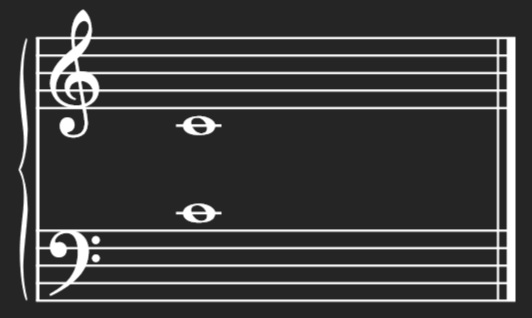
Middle C is the exact same physical key on your piano, whether it is written as the lowest note for your right hand or the highest note for your left hand. It acts like a hinge that locks both staves together into one giant map of the keyboard.
Meeting in the Middle
When a song has notes hovering around Middle C, your hands will be physically close together. The tricky part is training your eyes to smoothly hand off the melody from the Bass Clef to the Treble Clef without pausing or getting confused.
Self-Check Questions
- Question: Imagine a scale walking up the keys. Your left hand plays A (top line of Bass Clef), B (the space just above it), and then strikes Middle C. If the scale keeps going up, which notes will your right hand take over to play next?
Click to reveal answer
Answer: D (the space just below the Treble Clef) and E (the bottom line of the Treble Clef). - Question: True or False: Middle C written in the Treble Clef is a completely different physical key than Middle C written in the Bass Clef.
Click to reveal answer
Answer: False! It is the exact same key on your piano. - Question: What visual clue tells you that you should read both the Treble and Bass staves at the same time?
Click to reveal answer
Answer: The bracket (or brace) connecting the two staves on the far left side.
Practice Session: Meeting in the Middle
The Goal: Get comfortable reading notes right in the center of the keyboard where your left and right hands meet.
The Execution: Open JazzPianoLab and run through this Grand Staff exercise:
- 4. Grand Staff Crossing: Practice passing notes smoothly back and forth between your left and right hands around Middle C.
Don't have JazzPianoLab yet?
Reading about theory is only half the battle. To truly learn sight-reading, your hands need to react instantly. Plug in your MIDI keyboard and let our interactive engine guide you through these exact exercises.
Start 7-Day Free Trial (No Credit Card)Ready to build your musical foundation?
Unlock Interactive Practice for this course and the entire JazzPianoLab training library today.