Table of Contents
17. Whole Steps & Half Steps
Theory Lesson: Measuring the Distance
If you want to read sheet music smoothly, you can't just stare at the letters (C, D, E) one by one. You need to start seeing the distance between the notes. In music, we measure distance using just two basic rulers: the Half Step and the Whole Step.
The Half Step (The Smallest Move)
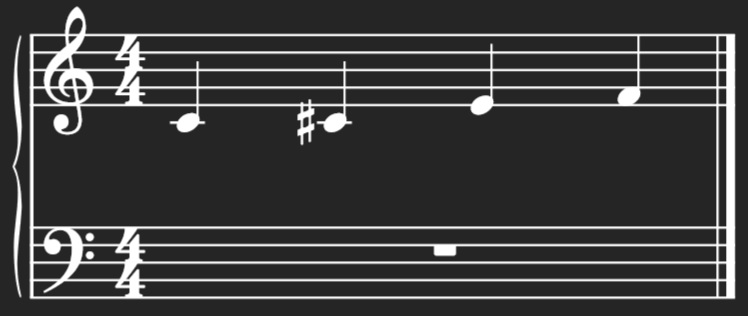
A half step is the tiniest jump you can make on a piano. It is the distance from one physical key to the very next physical key, with absolutely no keys skipped in between.
- Moving from a white C key up to the black C♯ key is a half step.
- Watch out—white keys can be half steps too! Moving from E to F is a half step because there is no black key between them.
The Whole Step (The Skip)
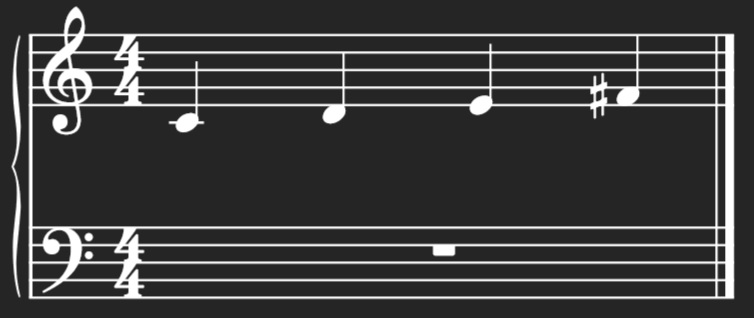
A whole step is just two half steps glued together. To play a whole step, you move up or down, and you must skip exactly one physical key in the middle.
- Moving from C to D is a whole step (because you are skipping over the black C♯ key in the middle).
- Moving from E to F♯ is also a whole step (because you are skipping over the white F key in the middle).
Sight-reading is basically just quick math for your fingers. When you see two notes next to each other on the page, your brain quickly figures out if it is a whole step or a half step so your hand knows exactly how far to stretch.
Self-Check Questions
- Question: Is the distance between B and C a half step or a whole step?
Click to reveal answer
Answer: A half step! (Just like E and F, there is no black key between them). - Question: To play a whole step, how many physical keys do you need to skip over?
Click to reveal answer
Answer: Exactly one key (it doesn't matter if you skip a black key or a white key, as long as it's just one). - Question: Moving from E to F is a half step. What note do you land on if you go a whole step above E?
Click to reveal answer
Answer: F♯.
Practice Session: Keyboard Geometry
The Goal: Train your hands to instantly feel the physical distance of a whole step versus a half step.
The Execution: Open JazzPianoLab and run through these Sight-Reading exercises:
- 17.1 The Half Step Movement: Play sequences that move entirely by half steps. Feel how your fingers slide right to the very next key, whether it's black or white.
- 17.2 The Whole Step Movement: Play sequences built only on whole steps. Make sure you are always skipping exactly one physical key.
- 17.3 The Distance Calculator: A mixed sequence of half and whole steps. Your eyes have to do the quick math so your fingers know how far to reach!
Don't have JazzPianoLab yet?
Reading about theory is only half the battle. To truly learn sight-reading, your hands need to react instantly. Plug in your MIDI keyboard and let our interactive engine guide you through these exact exercises.
Start 7-Day Free Trial (No Credit Card)Ready to build your musical foundation?
Unlock Interactive Practice for this course and the entire JazzPianoLab training library today.