Table of Contents
22. The Tritone
Theory Lesson: Understanding Harmonic Tension
It is time to meet the most famous, unstable, and dissonant interval in music: The Tritone. It sits exactly in the center of an octave and is made up of exactly three whole steps.
The Visual Deception
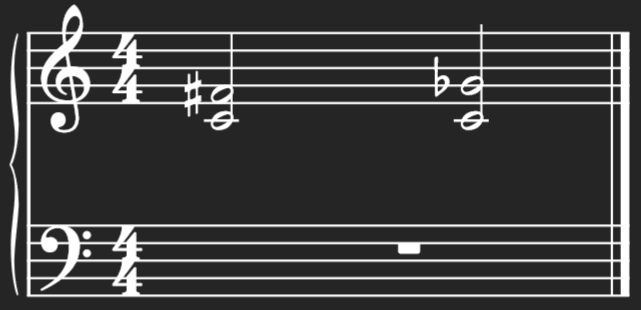
The tricky thing about the tritone is that it does not have its own unique shape on the page. Depending on how the composer writes it, it will look exactly like a perfect 4th (called an Augmented 4th) or a perfect 5th (called a Diminished 5th).
You cannot spot a tritone just by looking at the blank note heads on the staff. You have to read the key signature or the accidentals (sharps and flats) next to the notes to know it is there.
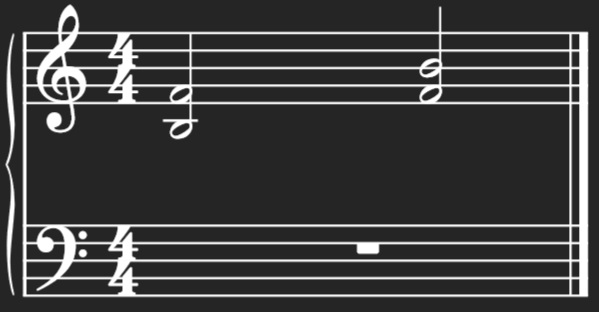
The White Key Anchor (B to F)
There is only one natural tritone on the white keys of the piano: the distance between B and F (or F and B). Every other tritone on the keyboard requires you to press at least one black key. Because of this, B and F are your anchor points. If you are playing entirely on the white keys and see a 5th starting on B, or a 4th starting on F, you are playing a tritone.
How It Feels
Because a tritone almost always mixes a black key and a white key, your hand has to reach a little deeper into the keyboard. It sounds incredibly tense and dissonant. In traditional harmony, this tension always wants to resolve to a more stable, consonant interval like a 3rd or a 6th.
Self-Check Questions
- Question: True or False: You can spot a tritone just by looking at the distance between the note heads on the staff lines.
Click to reveal answer
Answer: False. Visually, it looks exactly like a 4th or a 5th. You must read the accidentals or the key signature to identify it. - Question: Which two white keys naturally form a tritone?
Click to reveal answer
Answer: B and F (or F and B). - Question: What is the main musical function of a tritone?
Click to reveal answer
Answer: It creates instability and harmonic tension that wants to resolve to a stable chord.
Practice Session: Playing the Tritone
The Goal: Train your ears to instantly recognize the dissonance of a tritone, and train your eyes to spot it on the sheet music.
The Execution: Open JazzPianoLab and run through these Sight-Reading exercises:
- 22.1 The B-F Anchor: Master the only natural white-key tritone. Practice locking your hand into this specific shape across different octaves.
- 22.2 The Accidental Shift: Play perfect 4ths and 5ths, then alter one note with an accidental to turn it into a tritone.
- 22.3 Tritones Walk: Play C Major scale using tritones.
- 22.4 Tension and Resolution: Play a tense tritone and resolve it by moving inward to a 3rd or outward to a 6th.
Don't have JazzPianoLab yet?
Reading about theory is only half the battle. To truly learn sight-reading, your hands need to react instantly. Plug in your MIDI keyboard and let our interactive engine guide you through these exact exercises.
Start 7-Day Free Trial (No Credit Card)Ready to build your musical foundation?
Unlock Interactive Practice for this course and the entire JazzPianoLab training library today.