Table of Contents
16. Enharmonic Equivalents (Two Names, One Key)
Theory Lesson: Musical Spelling Words
One of the wildest things for beginners to discover is that on a piano, a single physical key can actually have more than one name!
Look at the black key sitting right between C and D.
- If you start at C and step up to the right, we call it C♯.
- If you start at D and step down to the left, we call it D♭.
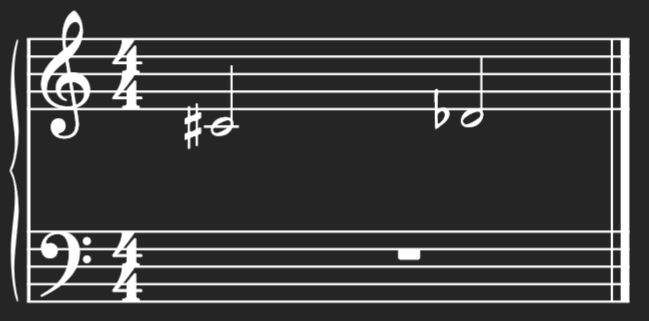
C♯ and D♭ are the exact same physical key on your keyboard. They sound completely identical. In music theory, we call these Enharmonic Equivalents (which is just a fancy way of saying "same sound, different spelling").
Why Do We Spell Them Differently?
If they are the exact same key, why make things complicated? Because music is a language with strict grammar rules.
Think of the English words "There," "Their," and "They're." They all sound exactly the same when you say them out loud, but if you use the wrong one in a book, the grammar of the sentence is broken. In music, C♯ and D♭ sound the same, but they belong to totally different musical families (like scales and chords).
For now, your only job is to break the visual trick in your brain. You just need to train your hands to strike the exact same black key, whether your eyes see a sharp or a flat!
Self-Check Questions
- Question: What is the enharmonic equivalent (the other name) for A♯?
Click to reveal answer
Answer: B♭. - Question: True or False: To play an enharmonic equivalent, you have to find a different key on the piano that sounds similar.
Click to reveal answer
Answer: False! You press the exact same physical key. - Question: Why don't we just give every black key one single name to make it easy?
Click to reveal answer
Answer: Because the specific spelling tells musicians how that note fits into the "grammar" of the specific scale or chord being played.
Practice Session: The Translation Game
The Goal: Prove to your hands and eyes that different symbols on the page often mean the exact same physical movement.
The Execution: Open JazzPianoLab and run through these Sight-Reading exercises:
- 16.1 Enharmonic Pairs: Practice playing the same note with different enharmonic equivalents.
Don't have JazzPianoLab yet?
Reading about theory is only half the battle. To truly learn sight-reading, your hands need to react instantly. Plug in your MIDI keyboard and let our interactive engine guide you through these exact exercises.
Start 7-Day Free Trial (No Credit Card)Ready to build your musical foundation?
Unlock Interactive Practice for this course and the entire JazzPianoLab training library today.