Table of Contents
20. Reading Wider Gaps (4ths & 5ths)
Theory Lesson: Stretching the Hand
As the chords you play get wider, you won't have time to stop and count every single line and space on the staff. Instead, you need to recognize the visual shape of the gap. Today, we stretch the hand a bit further to read 4ths and 5ths.
Spotting the 4th
A 4th spans four notes in a scale (like C up to F). Visually, a 4th always looks "mixed" on the staff:
- If the bottom note is on a Line, the top note is on a Space.
- If the bottom note is on a Space, the top note is on a Line.
It looks like a medium-sized gap on the page. When you see this mixed shape, your hand will naturally open up, usually stretching from your thumb (1) to your ring finger (4).
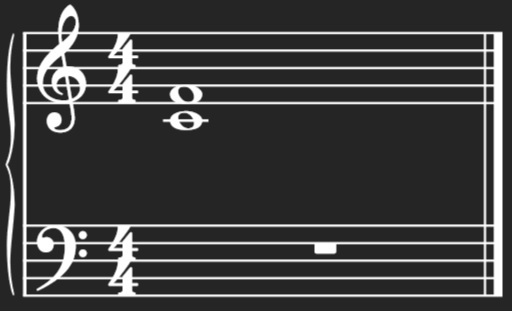
White Key 4ths in C Major
If you stick entirely to the white keys, almost every 4th you play will sound perfect and balanced (a Perfect 4th). There is only one exception on the whole keyboard: F-B. This creates a very tense, spooky sound called a Tritone (which we'll explore later!).

Spotting the 5th
A 5th spans five notes (like C up to G). It is the powerful, stable anchor of almost all modern chords. Visually, a 5th is perfectly symmetrical—just like a 3rd, but with a clear gap in the middle:
- Line to Line: (Skipping exactly one empty line in the middle).
- Space to Space: (Skipping exactly one empty space in the middle).
When your eyes see this empty line or space floating between two note heads, your hand should automatically lock into a wide shape, using your thumb (1) and your pinky (5).
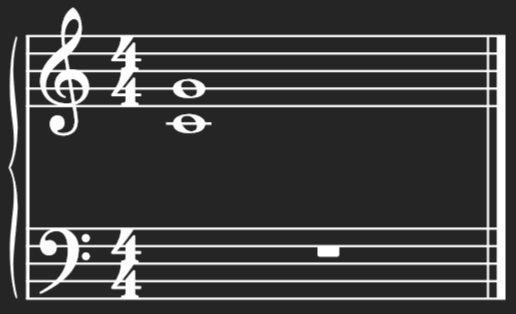
White Key 5ths in C Major
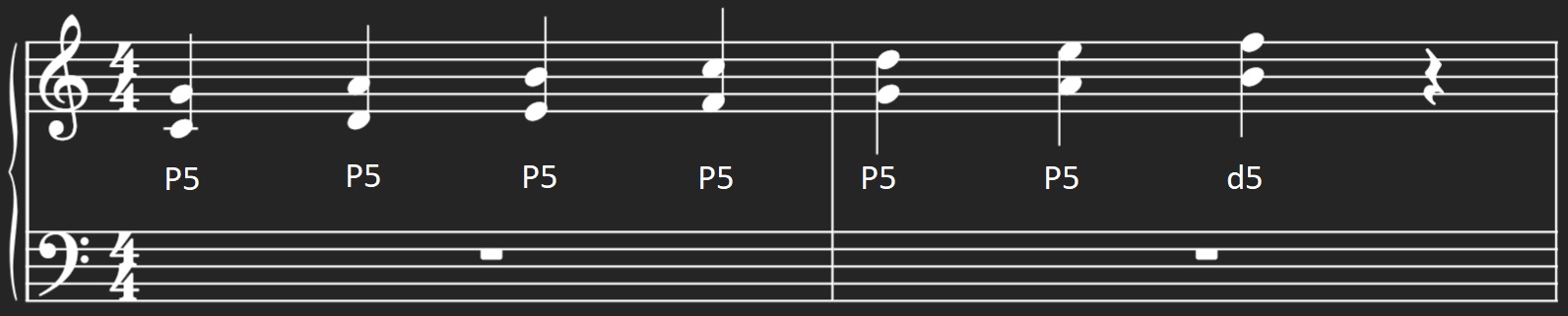
Just like 4ths, staying on the white keys gives you beautiful Perfect 5ths almost everywhere. The only crunch happens on B-F (our old friend, the Tritone).
Self-Check Questions
- Question: If the bottom note is on a space, and the top note is on the very next space above it, what is the interval?
Click to reveal answer
Answer: A 3rd! (Because there is no gap in the middle). - Question: If the bottom note is on a space, and the top note is on the second space above it (leaving an empty space between them), what is the interval?
Click to reveal answer
Answer: A 5th. - Question: What fingers do you normally use to play a Perfect 5th?
Click to reveal answer
Answer: The thumb (1) and pinky (5).
Practice Session: Locking in the Shapes
The Goal: Train your eyes to instantly spot the difference between the "mixed" shape of a 4th and the symmetrical "gap" of a 5th.
The Execution: Open JazzPianoLab and run through these Sight-Reading exercises:
- 20.1 The 4th Stretch: Walk up the C Major scale playing harmonic 4ths. Feel your hand lock into that comfortable thumb-to-ring-finger shape.
- 20.2 The 5th Anchor: Play the C Major scale using wide, powerful 5ths. Get used to spanning the gap with your thumb and pinky.
- 20.3 4ths vs. 5ths Contrast: A randomized mix jumping between 4ths and 5ths. You have to read the shapes quickly to know if your hand needs to contract or expand.
- 20.4 Leaping Melodies: Read a sequence of wide 4ths and 5ths played melodically (one note at a time) to connect how these big jumps look horizontally on the page.
Don't have JazzPianoLab yet?
Reading about theory is only half the battle. To truly learn sight-reading, your hands need to react instantly. Plug in your MIDI keyboard and let our interactive engine guide you through these exact exercises.
Start 7-Day Free Trial (No Credit Card)Ready to build your musical foundation?
Unlock Interactive Practice for this course and the entire JazzPianoLab training library today.