Table of Contents
8. The Quarter Note & 4/4 Time
Theory Lesson: Finding the Beat
Music without a steady beat is just a bunch of random sounds. The heartbeat of almost all modern music is a steady pulse called the beat.
To keep things organized on the page, we group these beats into small boxes called measures (or bars). We separate these measures using vertical lines drawn through the staff, called bar lines. When a song is completely over, it ends with a thick double bar line.

The Time Signature
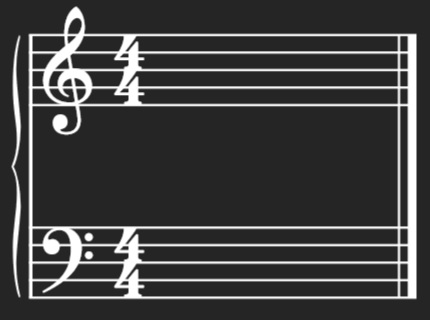
Right at the beginning of a song, next to the clef, you will see two numbers stacked on top of each other. This is the Time Signature.
The most common one in the world is 4/4 time (sometimes called Common Time).
- The Top Number (4): Tells you how many beats are in each measure. (Here, it's four beats).
- The Bottom Number (4): Tells you what kind of note equals one beat. (The "4" means a quarter note).
The Quarter Note
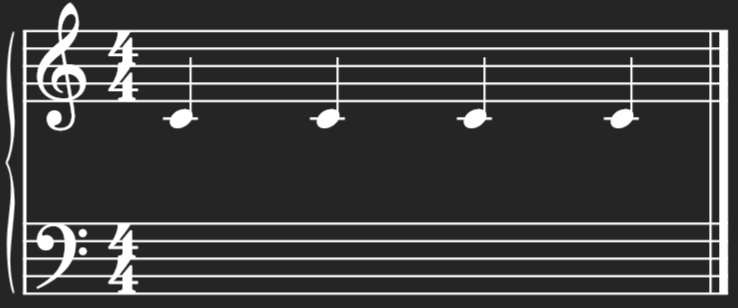
The quarter note is your rhythmic anchor. It looks like a solid black dot attached to a straight vertical stem. In 4/4 time, playing four quarter notes fills the whole measure perfectly.
When you practice with a metronome in JazzPianoLab, every single "click" you hear represents exactly one quarter note!
Up or Down? Stem Direction
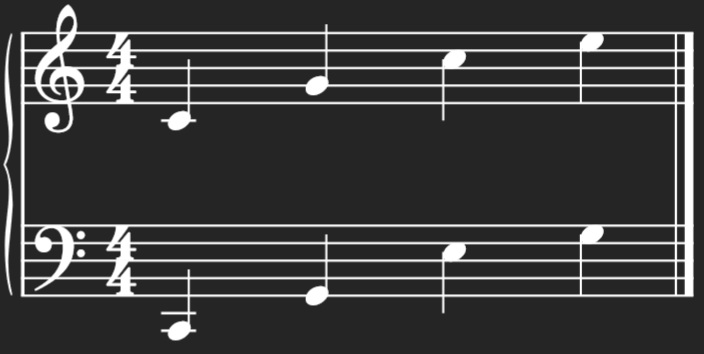
You might notice that the stems on the notes sometimes point up, and sometimes point down. Here is the simple rule: if a note sits below the middle line of the staff, its stem points up on the right side. If it sits on or above the middle line, the stem points down on the left side.
Don't worry—this doesn't change how the note sounds at all! It just keeps the sheet music looking neat and tidy so the stems don't crash into each other.
Self-Check Questions
- Question: In 4/4 time, how many quarter notes do you need to completely fill two measures?
Click to reveal answer
Answer: Eight quarter notes total (four in the first measure, plus four in the second). - Question: What is the vertical line that separates groups of notes called?
Click to reveal answer
Answer: A bar line! It divides the music into equal measures. - Question: Visually, how can you spot a quarter note?
Click to reveal answer
Answer: It has a solid, filled-in black note head attached to a straight stem.
Practice Session: Playing on the Beat
The Goal: Lock into the metronome and feel the steady pulse of the quarter note.
The Execution: Open JazzPianoLab and run through these Rhythm exercises:
- 8.1 Quarter Notes: Single Key Pulse: Strike one note perfectly in time with every click of the metronome to lock in your internal clock.
- 8.2 Quarter Notes: Hand to Hand: Keep the steady beat going while trading notes back and forth between your left and right hands.
- 8.3 Quarter Notes: Reading Skips: Play quarter notes that jump around the staff. The challenge is finding the next key without slowing down the beat!
Don't have JazzPianoLab yet?
Reading about theory is only half the battle. To truly learn sight-reading, your hands need to react instantly. Plug in your MIDI keyboard and let our interactive engine guide you through these exact exercises.
Start 7-Day Free Trial (No Credit Card)Ready to build your musical foundation?
Unlock Interactive Practice for this course and the entire JazzPianoLab training library today.