Table of Contents
10. Rests & The Art of Silence
Theory Lesson: Playing the Silence
Miles Davis famously said, "Music is the space between the notes." In sheet music, silence isn't just an empty spot on the page—it is a specific instruction telling you exactly when to stop playing. We call these instructions Rests.
Just like notes tell you how long to hold a key down, rests tell you exactly how long to keep your hands off!
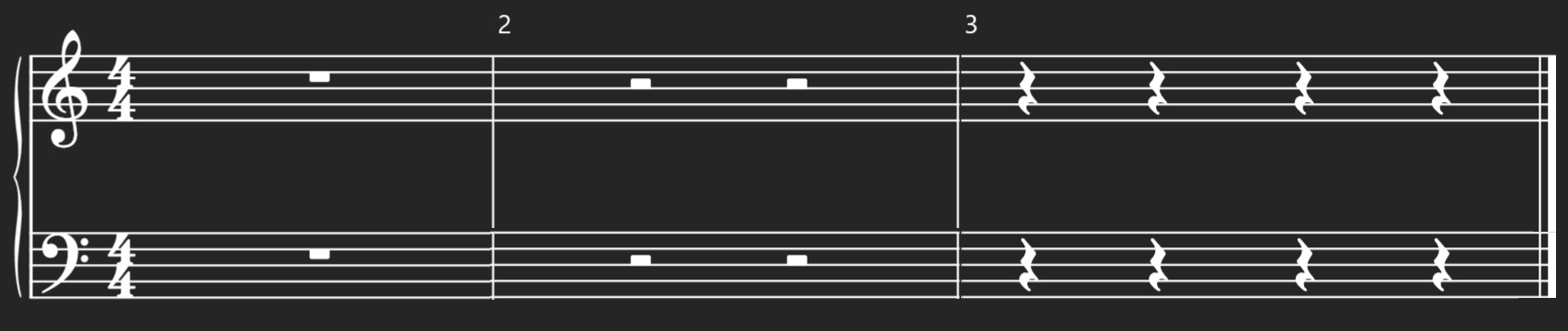
- The Whole Rest: Looks like a solid block hanging below the fourth line (think of a hole in the ground). It means a full measure (four beats) of total silence.
- The Half Rest: Looks like a solid block sitting on top of the middle line (like a top hat). It means two beats of silence.
- The Quarter Rest: Looks like a squiggly lightning bolt. It means exactly one beat of silence.
The Golden Rule: Lift Your Fingers!
Rests are actually where a lot of beginners trip up. When you see a quarter note followed by a quarter rest, you have to physically lift your finger off the key exactly on Beat 2. If you let your finger lazily hang out on the key during the rest, the sound bleeds over, making the music sound messy and ruining the groove.
Self-Check Questions
- Question: A measure has two quarter notes and one rest. To equal 4 beats total, what type of rest does it have to be?
Click to reveal answer
Answer: A Half Rest (because it's worth 2 beats). - Question: Visually, does a whole rest hang below a line, or sit on top of a line?
Click to reveal answer
Answer: It hangs below the 4th line (just remember: it looks like a hole in the ground!). - Question: What happens to the music if you forget to lift your finger during a rest?
Click to reveal answer
Answer: The previous note keeps ringing out, which destroys the groove and makes everything sound muddy.
Practice Session: Catching the Breaks
The Goal: Train your hands to physically snap off the keys the second a rest appears.
The Execution: Open JazzPianoLab and run through these Rhythm exercises:
- 10.1 Quarter Rests: The Quick Lift: Play a note on Beat 1, and lift completely on Beat 2. Repeat this to build the habit of letting go.
- 10.2 Half Rests: Play and Wait: Play two notes, then rest for two beats. Keep your hands totally off the keyboard for the second half of the measure!
- 10.3 Off-Beat Drops: Rests on the Downbeat: Rest on Beats 1 and 3, and only play on Beats 2 and 4. It feels a bit backwards at first, but it builds incredible rhythm.
- 10.4 Mixed Rests: Reading the Silence: A full mix of notes and rests jumping across the staff to test your new reflexes.
Don't have JazzPianoLab yet?
Reading about theory is only half the battle. To truly learn sight-reading, your hands need to react instantly. Plug in your MIDI keyboard and let our interactive engine guide you through these exact exercises.
Start 7-Day Free Trial (No Credit Card)Ready to build your musical foundation?
Unlock Interactive Practice for this course and the entire JazzPianoLab training library today.